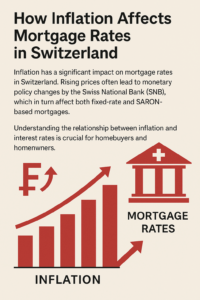
How inflation affects mortgage rates in Switzerland
Inflation plays a major role in shaping the financial landscape in Switzerland, and one of the areas where its impact is felt most strongly is the mortgage market. Understanding how inflation influences Swiss mortgage rates can help homebuyers, property investors, and homeowners make more informed decisions. Switzerland’s financial system is known for its stability, but even here, inflation directly affects interest rates, affordability, and long-term housing costs (how inflation affects mortgage rates in Switzerland).
At its core, inflation refers to the rise in prices of goods and services over time. When inflation increases, the purchasing power of the Swiss franc decreases. To counter this, the Swiss National Bank (SNB) typically adjusts its monetary policy—most notably the key interest rate. These SNB policy moves influence borrowing costs across the economy, including mortgage rates. When inflation rises beyond the SNB’s target range, the central bank may increase rates to stabilize the economy. Conversely, when inflation is low, interest rates tend to remain stable or decrease.
In Switzerland, mortgage rates are primarily categorized into fixed-rate mortgages, SARON-based mortgages, and hybrid options. Inflation impacts each of these differently. Fixed mortgage rates are most sensitive to long-term economic expectations. When inflation is expected to rise, banks increase fixed-rate mortgages to protect themselves from future uncertainty. This makes fixed rates less attractive during inflationary periods. SARON mortgages, on the other hand, are tied to short-term interest rate movements, which respond more directly to SNB decisions. When the SNB raises rates to fight inflation, SARON mortgage costs typically increase within weeks or months.
Inflation also affects mortgage affordability. Swiss affordability rules require that total housing costs (interest, maintenance, and amortization) do not exceed one-third of gross income. When inflation causes rates to rise, buyers may find themselves unable to meet affordability thresholds—even if property prices remain stable. As a result, some households choose to delay purchasing or refinance differently to maintain compliance with lending rules.
Real estate prices may also be indirectly affected by inflation. In high-inflation periods, construction costs often rise due to increased prices for materials and labor. This can lead to higher property prices, reduced new supply, and tighter housing availability. However, Switzerland’s real estate market is influenced by additional factors such as immigration, zoning restrictions, and local demand, making outcomes more nuanced.
For homeowners with existing mortgages, inflation can create both risks and opportunities. Those locked into low fixed rates benefit when inflation pushes rates higher, as their borrowing cost does not change. Conversely, buyers with SARON mortgages may see their monthly payments increase as the SNB responds to inflationary pressures.
Understanding how inflation affects mortgage rates in Switzerland is essential for smart financial planning. By monitoring SNB announcements, market forecasts, and inflation indicators, homeowners and buyers can better determine the ideal mortgage type, timing, and strategy.