Swiss Mortgage Requirements: Income, Equity & Affordability
Understanding the mortgage requirements in Switzerland is essential for anyone looking to finance a home, whether you are a resident, expat, or investor. Swiss lenders follow strict affordability criteria designed to ensure long-term financial stability for borrowers. By knowing exactly what banks evaluate — income, equity, and affordability calculations — you can improve your chances of securing the best mortgage terms (Swiss mortgage requirements).
Income Requirements
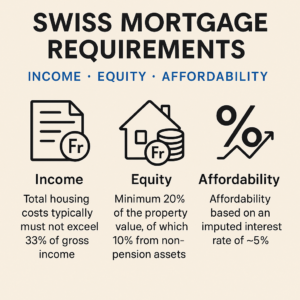
Swiss mortgage institutions place a strong emphasis on your stable and verifiable income. This includes salary, bonuses that are guaranteed, pension income, or business income if you are self-employed. Typically, lenders require that your total housing costs do not exceed one-third of your gross annual income. Housing costs include interest (calculated using a theoretical rate), amortization payments, and property maintenance.
For employees, lenders will usually request your last three salary statements and your annual tax statement. For self-employed borrowers, you should expect to provide the last two to three years of balance sheets, income statements, and tax filings.
Equity Requirements
Swiss mortgage rules require a minimum of 20% equity, with at least 10% of the property value coming from cash or non-pension sources. The remaining 10% can come from your pension fund (2nd or 3rd pillar), depending on eligibility and withdrawal rules. Equity can include savings, investment assets, or existing property equity, and it directly influences the size of your mortgage and your long-term costs.
Increasing your equity contribution may help you negotiate lower interest rates or avoid higher amortization requirements.
Affordability Rules
Affordability in Switzerland is calculated using a stress-tested interest rate — generally around 4.5% to 5%, regardless of current market rates. This ensures that homeowners can comfortably manage payments even if rates rise in the future. In addition to interest, lenders factor in 1% of property value for maintenance and 1% for amortization if needed.
To qualify, total housing expenses must not exceed roughly 33% of your gross income. If you surpass this threshold, you may need to increase equity or consider a less expensive property.
Property Valuation Standards
Swiss banks also assess the property itself. They lend based on the bank’s internal valuation, not necessarily the purchase price. If the valuation falls below the agreed sale price, you must cover the difference with additional equity.
Why These Requirements Matter
Swiss mortgage requirements are designed to protect both the borrower and the lender. For many buyers, especially first-timers or expats, these rules may initially seem strict — but they ensure long-term sustainability and prevent financial stress.
Get Help Navigating Swiss Mortgage Rules
Every lender evaluates applications slightly differently, and expert guidance can make the process easier. If you want assistance calculating your affordability, finding the right mortgage structure, or maximizing your equity options, a mortgage broker can guide you through every step.