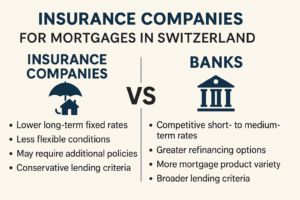
Insurance companies vs banks mortgages Switzerland
When buying property in Switzerland, one of the most important decisions is choosing the right mortgage provider. While most borrowers naturally turn to traditional banks, insurance companies have become increasingly competitive in the mortgage market. Understanding the differences between these two provider types can help homebuyers secure better rates, more favorable terms, and additional financial advantages (insurance companies vs banks mortgages Switzerland).
Interest Rates & Pricing Structure
One of the biggest distinctions between insurance companies and banks is the way they price their mortgages. Insurance companies tend to offer some of the lowest long-term fixed mortgage rates in Switzerland. Their business model allows them to invest in long-duration assets, making long-term mortgages—such as 10 to 20-year fixed terms—particularly attractive.
Banks, on the other hand, typically offer more competitive short- to medium-term rates, especially for SARON-based mortgages. If a borrower wants flexibility or expects rates to fall, banks often provide better options. However, their longer fixed rates are usually more expensive compared to insurance companies.
Mortgage Flexibility & Conditions
Banks generally provide greater flexibility. They offer multiple mortgage types (SARON, variable, fixed, hybrid) and allow easier refinancing or restructuring. Insurance companies, however, can be more rigid. Many require longer commitment periods and may not allow partial refinancing or early termination without significant penalties.
Additionally, insurance companies often demand that borrowers take out additional policies, such as life insurance or pillar 3a savings plans. While this can be seen as a restriction, the bundled products may benefit certain borrowers—especially those looking to optimize long-term retirement planning.
Affordability Rules & Lending Criteria
Both banks and insurance companies follow Swiss affordability rules: the theoretical housing burden cannot exceed 33% of household income. However, insurance companies tend to be more conservative, often requiring higher equity or more stable employment history. Banks may offer slightly more flexibility for borrowers who are self-employed or have variable income sources.
For buyers of investment properties or secondary residences, banks typically maintain broader and more specialized mortgage products. Insurance companies are more focused on owner-occupied homes.
Stability & Long-Term Security
One of the major advantages of choosing an insurance company is long-term rate stability. If a borrower wants to lock in a fixed rate for 15 to 25 years, insurance companies frequently provide more competitive and predictable pricing. This makes them ideal for families planning to stay long term and who value financial stability.
Banks, however, offer more product variety and better options for those who want to mix fixed and SARON tranches or adjust their mortgage strategy over time.
Which Option Is Better?
There is no universal answer—each borrower’s profile, financial goals, and long-term plans matter. Insurance companies are excellent for long-term fixed mortgages and stability, while banks excel in flexibility, hybrid structures, and short-term competitiveness. A well-informed comparison can save borrowers thousands of francs over the mortgage term.