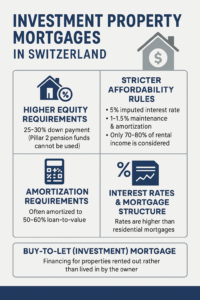
Investment Property Mortgages in Switzerland
Investing in Swiss real estate is considered one of the most stable and attractive long-term wealth-building strategies in Europe. With strong rental demand, low vacancy rates in major cities, and a robust legal framework, Switzerland continues to draw both domestic and international investors. However, financing an investment property differs significantly from obtaining a mortgage for a primary residence. Understanding these differences is essential for ensuring your investment is financially sound and fully compliant with Swiss lending requirements (investment Property Mortgages in Switzerland).
What Is an Investment Property Mortgage?
An investment property mortgage (also called a buy-to-let mortgage) is financing used to purchase real estate that will be rented out for income rather than lived in by the owner. These properties include apartments, multi-family buildings, and mixed-use units. Because rental properties carry higher financial and regulatory risks for lenders, the approval criteria are more stringent than for owner-occupied homes.
Higher Equity Requirements
Unlike primary residences, where only 20% equity is typically required, most Swiss banks require at least 25–30% down payment for investment properties. Some lenders may request up to 40%, especially for larger or multi-unit buildings. Additionally:
- Pillar 2 (pension fund) assets cannot be used for investment property purchases.
- Pillar 3a funds are also generally not accepted, as Swiss law restricts their use to primary residences.
This means the entire down payment must come from savings, securities, or other non-pension assets.
Stricter Affordability Rules
Swiss affordability rules for investment properties are more conservative because rental income may fluctuate. Banks typically apply:
- A 5% imputed interest rate
- 1% to 1.5% for maintenance & amortization
- Conservative rental income assumptions
- Stress tests to assess vacancy risks
In many cases, only 70–80% of expected rental income is counted toward affordability.
The borrower must demonstrate long-term financial stability even if rents change or interest rates rise.
Amortization Requirements
Investment property mortgages often require faster amortization compared to residential loans. Many lenders require amortization down to 50–60% loan-to-value over 15 years. Some banks may require more frequent amortization if the property is older or expected to require significant maintenance.
Interest Rates and Mortgage Structure
Interest rates for investment properties are generally higher than for primary residences, reflecting increased lender risk. Borrowers can choose from:
- Fixed-rate mortgages (popular for long-term stability)
- SARON-based mortgages (flexible but rate-sensitive)
- Tranche combinations (e.g., 5-year + 10-year fixed)
Lenders often encourage diversified tranching to manage refinancing risks.
Rental Market Considerations
Before approving financing, banks frequently analyze:
- Location and vacancy rate
- Historical rental data
- Expected yield and cash flow
- Property condition and renovation needs
Investment properties in high-demand urban areas (Zurich, Geneva, Basel, Lausanne) generally receive more favorable assessments.
Ideal for Long-Term Investors
Investment mortgages are best suited for investors seeking:
- Stable, long-term rental returns
- Capital appreciation in a secure real estate market
- Tax-deductible interest expenses
However, buyers must be prepared for higher equity needs, stricter affordability tests, and ongoing management responsibilities.