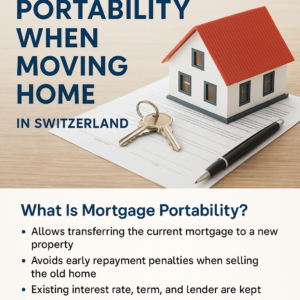
Mortgage Portability When Moving Home in Switzerland
Moving to a new home in Switzerland does not necessarily mean starting your mortgage from scratch. Thanks to mortgage portability—known as Hypothekenübertragung—homeowners can transfer their existing mortgage to a new property under certain conditions. This option can be highly advantageous, particularly when interest rates are rising or when your current mortgage terms are more favorable than what the market offers today. Understanding how mortgage portability works, its benefits, and its limitations helps you make a smarter financial decision when relocating (mortgage portability Switzerland).
What Is Mortgage Portability?
Mortgage portability allows you to keep your current mortgage contract, including its interest rate, term, and lending partner, and apply it to a newly purchased property. Instead of repaying your mortgage early (which can trigger costly penalties known as Vorfälligkeitsentschädigung), you can simply transfer the debt to your new home.
Not all mortgage types are fully portable, and not all lenders treat portability the same way. However, most fixed-rate mortgages and some SARON-based mortgages include portability clauses.
How Mortgage Portability Works
When you decide to sell your current home and buy a new one, your lender evaluates whether your mortgage can be transferred. The bank conducts a complete reassessment of the new property and updates your affordability calculation. The key steps include:
- Property valuation: The new home must meet lending criteria, including acceptable location, type, and condition.
- Affordability check: Your income must still satisfy the Swiss affordability rule, meaning total housing costs must typically remain below one-third of your gross income.
- Loan-to-value assessment: The mortgage amount cannot exceed 80% of the new property’s value. If the new property is more expensive, you may need to increase your equity.
- Transfer approval and contract updates: Once the bank approves the transfer, they prepare new documentation, linking the existing mortgage contract to the new property.
Benefits of Mortgage Portability
Portability can save Swiss homeowners a significant amount of money. The main advantages include:
- Avoiding early repayment penalties: Fixed-rate mortgages can incur large fees if terminated early. Portability bypasses these costs.
- Keeping a favorable interest rate: If you locked in a low rate years ago, transferring it can be financially strategic—especially in a high-rate environment.
- Simplifying the financing process: Keeping the same lender and contract reduces admin work and streamlines the transition to your new home.
- Maintaining existing mortgage terms: You keep the same maturity dates, amortization structure, and payment rhythm.
Limitations and Potential Challenges
Mortgage portability is not guaranteed. Some common obstacles include:
- New property not meeting lender criteria
- Affordability issues due to higher price or income changes
- Lender unwilling to refinance the gap if the new home is more expensive
- Non-portable mortgage products
If portability is not possible, your lender may offer partial portability, a combination mortgage, or a restructuring option.
Should You Use Mortgage Portability?
If you are moving home and currently hold a fixed-rate mortgage, portability is often worth exploring. Working with a mortgage broker helps you compare lender policies and evaluate whether portability or a new financing structure is more advantageous.